

A note on what changed from our earlier draft: it listed several specific 2026 fines and warning-letter counts. We could not find a public source for them, so we removed them. Everything below is tied to a source you can open.
Terms used in this guide
| Term | Plain meaning |
|---|---|
| Material connection | Any relationship with a brand that could affect how believable your recommendation is: payment, free products, tokens, equity, family or employment ties. |
| Touting | A US securities-law term for promoting a security without disclosing what you were paid for it. |
| Disgorgement | Handing back the money earned from the violation. |
| Financial promotion | UK term for any communication that invites someone to invest. Crypto promotions are covered. |
| MiCA | The EU's Markets in Crypto-Assets Regulation, which sets rules for crypto firms and their marketing. |
| CASP | Crypto-asset service provider, such as an exchange. MiCA requires authorisation. |
| Finfluencer | An influencer who talks about money, investing or crypto. |
The rules that apply, by region
United States: FTC and SEC
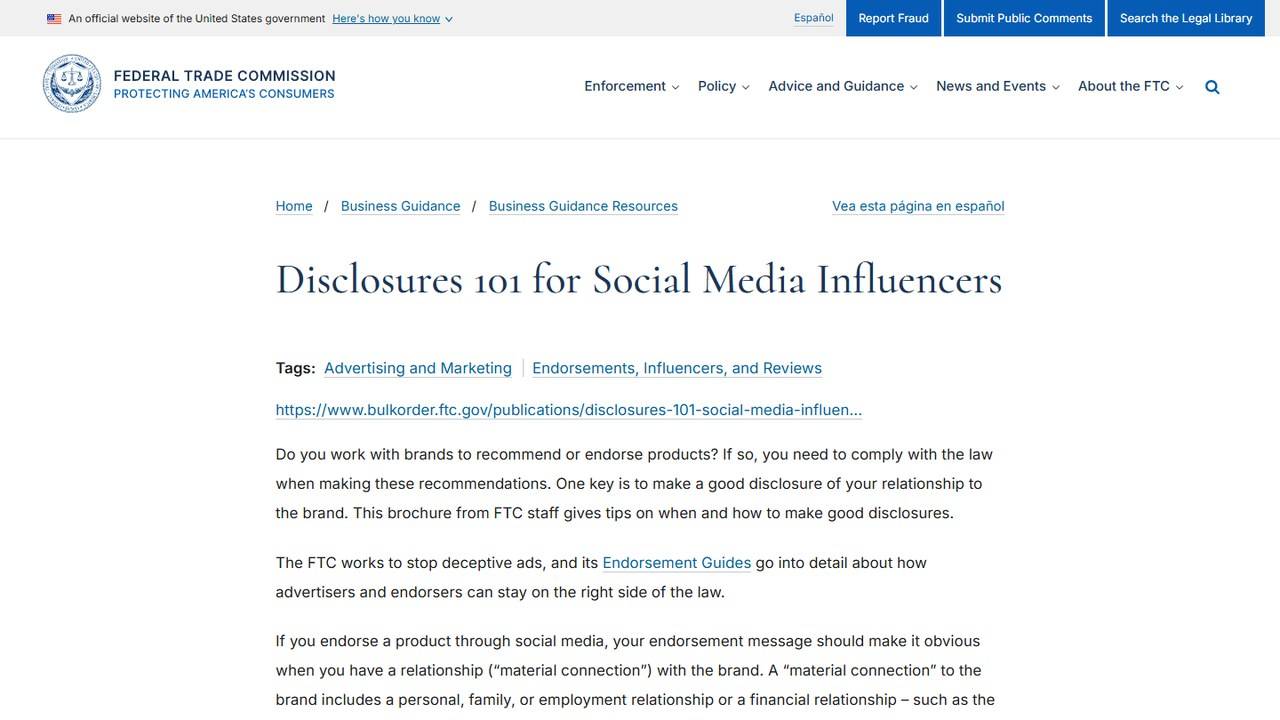
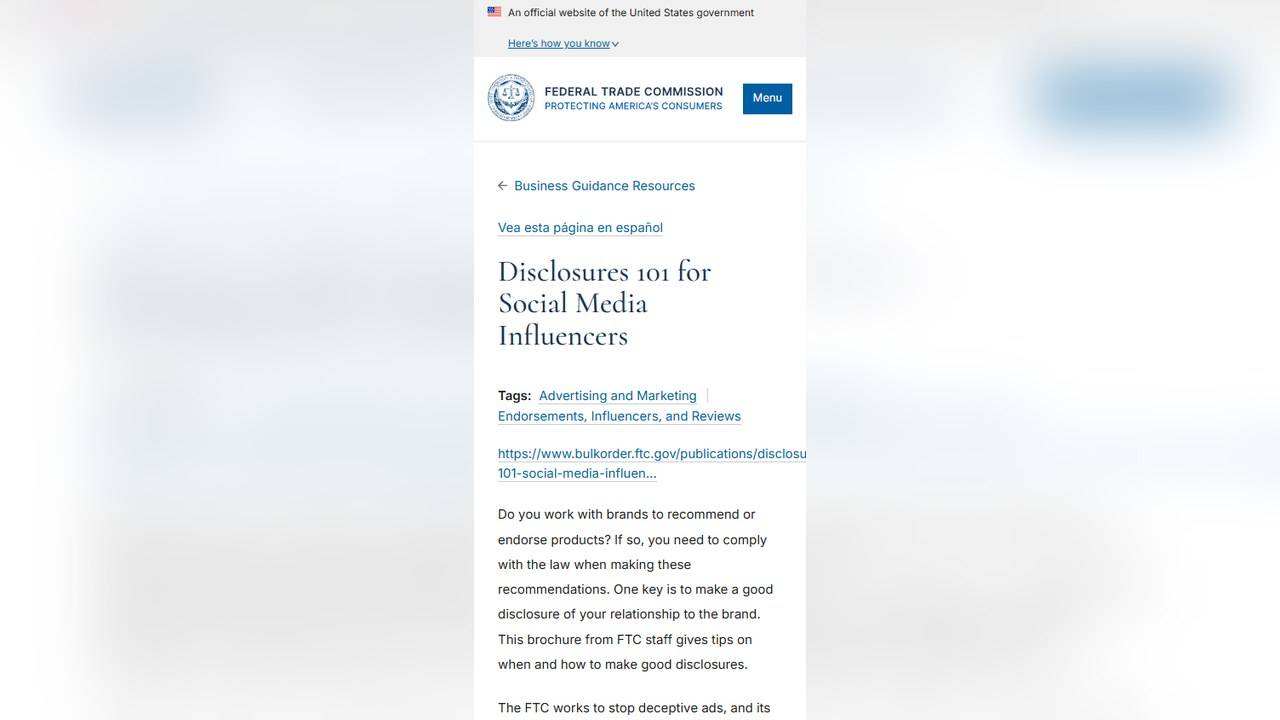
The FTC's influencer guidance, Disclosures 101 for Social Media Influencers, says a material connection includes a financial relationship such as a brand paying you or giving you free or discounted products. It adds that you must disclose even if you think your view is unbiased, that tags and likes can count as endorsements, and that it is your responsibility, not the brand's. On placement, the FTC says a disclosure is likely to be missed if it sits only on a profile page, at the end of a post or video, or behind a "more" click, and that it should not be buried among hashtags. For video, it should be in the video itself, not only the description, and for live streams it should be repeated. The FTC's endorsements page notes the Endorsement Guides were revised in 2023.
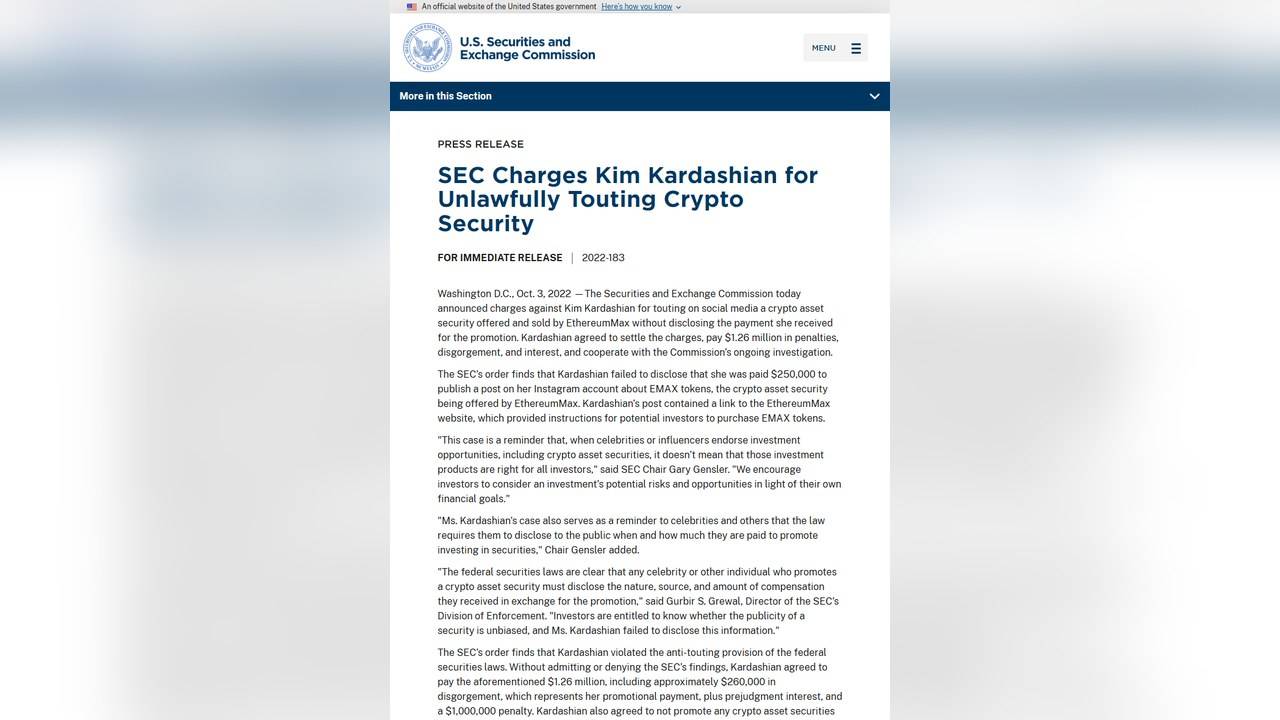
For crypto there is a second layer. If the token counts as a security, paid promotion without disclosing the payment can be charged as touting. The clearest primary source is the SEC's 2022-183 press release: Kim Kardashian settled for $1.26 million, made up of about $260,000 of disgorgement (her $250,000 fee plus interest), a $1,000,000 penalty, and a three-year ban on promoting crypto asset securities, after an Instagram post about EthereumMax tokens. The SEC said anyone promoting a crypto asset security must disclose the nature, source and amount of compensation.
Our reading: the key legal question is whether the token is a security, which stays contested for many tokens. But disclosure under FTC rules does not depend on that question. Disclose either way.
On fines, secondary sites quote different FTC per-violation maximums ($43,792, $51,744 and $53,088 in results we saw on 2026-11-18). The figure is inflation-adjusted and we did not confirm the current number with the FTC, so check it before relying on it.
United Kingdom: FCA financial promotions
According to a Coinranking summary checked on 13 October 2026, the FCA's crypto promotion rules have applied since 8 October 2023. A promotion to UK consumers must come through one of four routes: from an FCA-authorised firm, approved by one, from an FCA-registered crypto firm, or under an exemption. It must carry a prescribed risk warning, and it bans refer-a-friend and sign-up bonuses and gives first-time investors a 24-hour cooling-off period. The FCA's own guidance, FG24/1, is described in its search listing as applying to financial promotions on social media and to influencers, and says the rules are technology neutral. The same summary says the new UK crypto regime starts on 25 October 2027.
Why this matters to creators: in the UK the legal risk can fall on the person communicating the promotion, not only the firm. We read the FCA guidance summary but could not load the full FCA pages in our screenshot tool (a bot check blocked it), so confirm the exact obligations with the FCA text.
European Union and France: MiCA and the influencer law
Under MiCA, per the same Coinranking summary, crypto marketing must be clearly marked as marketing, fair, clear and not misleading, and consistent with the white paper. It also says the longest MiCA transition period ended on 1 July 2026.
France adds a specific law. CryptoSlate's profile of Loi n degrees 2023-451 (last verified 6 July 2026) says paid commercial influencers may not promote covered crypto-asset services or crypto-assets unless the advertiser or issuer has the relevant MiCA authorisation, and that the current wording applies from 1 July 2026. It also describes a labelling duty (for example "publicite" or "collaboration commerciale") and a written-contract requirement above a €1,000 threshold from 1 January 2026. Two French law firm results in our search (Kohen Avocats and ORWL) describe the same 1 July 2026 change; we read only the snippets.
Our reading: a creator who is based outside France but targets French viewers should check this rule, because the profile says it also reaches some non-EU actors who target the French public.
Enforcement on the public record
| Case | Date | What happened | Source and status |
|---|---|---|---|
| Kim Kardashian, EthereumMax | 3 Oct 2022 | $1.26M settlement for an undisclosed $250,000 paid post | SEC press release 2022-183, primary source, read in full |
| Floyd Mayweather and DJ Khaled, Centra Tech | 29 Nov 2018 | Settled for $614,775 and $152,725 respectively | Everything-PR casebook, secondary source, not checked against SEC filings |
| Celebrity group tied to Justin Sun, TRX and BTT | 22 Mar 2023 | Eight celebrities charged for undisclosed promotion, six settled for about $400,000 combined, per the casebook | Everything-PR casebook, secondary source, not checked against SEC filings |
Source dates: checked 2026-11-18. We looked for 2026 cases against individual crypto influencers, including the ones our earlier draft described, and did not find a primary source for them in the SEC and FTC pages we could load or in search results. The SEC's 2026 annual enforcement summary in our search results discusses fraud against retail investors, which is a different kind of case. That does not prove no 2026 influencer case exists, only that we could not verify one.
Our reading: the best-documented cases are three to eight years old, and all hinge on the same fact, an undisclosed payment. The lesson for 2026 is that the rule has not changed, and the legal risk is high mainly in the US for tokens that look like securities, and in the UK and France where promotion rules are tighter.
Platform rules are separate from the law
Platform labels do not replace legal disclosure. Several secondary sites in our search (Bitrue and Auditsocials) say X updated its paid-partnership policy in 2026 to narrow crypto promotion and strengthen disclosure. We did not open X's own policy page, so treat that as unverified until you read it. In the other direction, a post that satisfies a platform label can still fail the FTC's placement guidance, for example if the label is hidden behind a "more" click.
A pre-publish checklist for creators and projects
| Question | If yes |
|---|---|
| Did you receive anything of value: cash, tokens, NFTs, equity, free access, a trip? | Disclose it in the post itself, at the start, in plain words such as "ad" or "sponsored". |
| Is the content a video or live stream? | Put the disclosure in the video and repeat it in a live stream, not only in the description. |
| Does the token look like an investment contract? | Assume SEC touting rules may apply and keep records of what you were paid and when. |
| Is any UK audience targeted? | Check the FCA promotion routes and the required risk warning before posting. |
| Is any French audience targeted? | Check whether the advertiser has MiCA authorisation and whether a written contract is required. |
| Do you hold the token you are discussing? | Say so. The FTC treats relationships broadly, and it protects your credibility. |
| Does the post promise returns? | Remove it. Coinranking's summary lists "guaranteed" and "risk-free" style claims as things to avoid. |
Where the rules are hard to enforce
Our reading, not a sourced finding: enforcement usually needs an identifiable person and a paper trail. Anonymous accounts and payments made in tokens through smart contracts are harder to trace, and regulators have limited staff. These factors can complicate investigations, but they do not establish which creators regulators will prioritise. That is a description of practical risk, not permission. The FTC says US law can apply to a poster abroad if the effect on US consumers is reasonably foreseeable, and the French law reaches some non-EU actors targeting France.
What we did not check
- We did not verify any 2026 individual enforcement case. Our earlier draft listed an SEC settlement with a YouTuber, 23 FTC warning letters and a French AMF fine. We found no public source for these, so they were removed.
- The Mayweather, Khaled and March 2023 figures come from a secondary casebook, not SEC documents. The Kardashian figures come from the SEC.
- UK and EU rules are summarised from a Coinranking article, the FCA's search listing for FG24/1 and a CryptoSlate profile. We could not load the full FCA pages and did not read the MiCA text or French statute directly.
- The FTC maximum penalty per violation varies across secondary sources, and we did not confirm the current figure.
- We did not check YouTube, TikTok, Telegram or X policy pages.
- This is not legal advice. Rules differ by country and by the type of token.
FAQ
Are crypto influencers required to disclose paid promotions?
In the US, the FTC says anyone with a material connection to a brand should disclose it, and that includes payment or free products. Securities law adds a duty when the promoted token is a security. UK and French rules are stricter for crypto, as described above.
What counts as compensation?
Per the FTC, anything of value given to you in connection with mentioning a product, including free or discounted products. We read that this covers tokens too, but the FTC page we read does not mention tokens by name.
Where should the disclosure go?
In the post or video itself, early and in plain words, and not only in a profile, a "more" section or a hashtag block, according to the FTC guidance.
What penalties are documented for crypto touting?
The best-documented example is the Kardashian settlement: $1.26 million plus an agreed three-year prohibition on promoting crypto-asset securities as part of the settlement. The FTC can also seek civil penalties, but we did not confirm the current maximum.
Do these rules apply if I post from outside the US?
The FTC says US law can apply if it is reasonably foreseeable that the post will affect US consumers, and that foreign laws might also apply.
Is promoting crypto in the UK allowed for an individual creator?
Only through a lawful route, with the required risk warning. If you are not authorised, a firm that is authorised and has the right permission may need to approve the content. Get advice before you publish.
This article is for information only and is not legal advice. This is not financial advice. Crypto assets are high risk, and readers should conduct their own research and seek regulated financial advice where appropriate. It reflects the sources we could open as of 2026-11-18. Rules change, so check the regulator's own pages and speak to a lawyer in each country you target.
Editorial credits
Checked by TheCCPress QC Team before publishing on November 19, 2026 for cause-and-effect claims, counter-evidence, labeling, headline accuracy, original value, factual consistency, metadata, authorship claims and risk disclosure: our AI review system checks every article before it goes live, and our duty editor monitors it after publication. Report an error.
TheCCPress uses AI for research, drafting and review. Our editorial team is responsible for every article and corrects or withdraws articles when needed. How we review.


